News

Level 4 Scholarship Students

Travel Risk Academy Scholarship: Meet Our Level 4 Recipients

We’re proud to introduce the four recipients of our Level 4 ATHE Award in Travel Risk Management scholarship: Mohammad Shafi Waris, Deborah Nwaukwa, Allan Kyeyune, and Daisy Barnham Selected from a highly competitive global pool, these individuals represent not only exceptional talent, but also the diverse perspectives that are essential to shaping the future of Travel Risk Management (TRM). A Truly Global Cohort This inaugural scholarship intake brings together professionals from the UK, Uganda, Afghanistan, and Nigeria – a reflection of the global nature of TRM today. “We’re delighted to welcome students from across the world into our inaugural intake. At our core, we believe that Travel Risk Management is a truly global discipline — one that thrives through diverse perspectives. These students have been practising TRM in their own ways for years, and we’re proud to now equip them with the tools and frameworks to further develop and advance TRM practices within their countries, and for generations to come.”Bex Deadman, Co-founder, Travel Risk Academy Powered by Partnership The Travel Risk Academy initially committed to funding two scholarships for the March cohort. Thanks to the generous support of AHNA Group, we were able to double this number — awarding a total of four fully funded places. This kind of collaboration is what makes meaningful, global impact possible. A Strong Global Response Interest in the scholarship programme has been overwhelming. We received applications from across the globe, including: Afghanistan, Brazil, Canada, India, Indonesia, Ireland, Nigeria, Uganda, the UK, and the USA. This level of engagement highlights both the growing demand for TRM education and the importance of making it accessible worldwide. Now Inviting New Partners We are now opening the door to a limited number of organisations interested in sponsoring future scholarships. By partnering with Travel Risk Academy, you can: ✔ Support the global development of Travel Risk Management✔ Expand access to training for professionals who may otherwise be excluded✔ Strengthen your reputation as a values-driven organisation✔ Build meaningful connections within a fast-growing TRM community Sponsorship Options 1 place – £699.99 + VAT 5+ places – 5% discount 10+ places – 10% discount Enquire: en*******@***************my.com Applications Now Open: September Intake We are now accepting applications for our September scholarship intake. If you’re passionate about advancing Travel Risk Management in your region and want to gain a globally recognised qualification, we encourage you to apply. ???? Apply here >

Travel Risk Academy Scholarship: Meet Our Level 4 Recipients Read More »

AI-Enabled Fraud

When the Threat Travels With Your People: AI-Enabled Fraud and the Duty of Care Gap

The Moment of Maximum Vulnerability Crisis disruption does not simply strand travellers. It creates the conditions in which they are most susceptible to manipulation. When flights are cancelled, rebooking queues are overwhelmed and official guidance is fragmented, travellers do what comes naturally: they search for help, they post on social media, they click on links that appear to offer resolution. Fraudsters understand this behaviour precisely because it is predictable, and they have learned to exploit it at scale. The Middle East conflict of early 2026 produced a textbook case study. Within days of widespread flight disruption across the Gulf, a coordinated wave of AI-assisted fraud activity targeted passengers of Emirates, Etihad and Qatar Airways. The techniques deployed were not crude. They were architecturally sophisticated, operationally fast and, in several cases, difficult to distinguish from legitimate airline communications. For corporate travel risk managers and duty of care professionals, this is not a consumer issue that sits at arm’s length. It is an operational exposure with direct liability implications. Four Attack Vectors Your Travellers Are Facing 1. Fake Social Media Accounts Impersonating Airlines On the platform X, fraudsters constructed accounts using airline branding, logos and generic service-oriented names such as “Support Team”, “Quick Response Team” or “Guest Services Care.” These accounts actively monitored public posts from distressed passengers and replied directly, initiating contact under the appearance of legitimate assistance. Santander UK’s fraud team confirmed it had already received reports from customers caught in this pattern. Etihad Airways issued a formal advisory on 11 March 2026 confirming the existence of multiple fake accounts impersonating the airline, and clarified that its only verified accounts on X are @Etihad and @EtihadHelp. The mechanics of the scam followed a consistent pattern: the passenger is drawn into a direct message exchange, asked to confirm personal and contact details, then directed to a money transfer application under the pretence of receiving a refund. Instead, funds are debited. Duty of care implication: Your travellers are searching for help in real time, often on personal devices, using personal accounts. Their interactions with apparent airline support are invisible to your travel management infrastructure. There is no trigger in your booking or tracking platform that flags this exposure. 2. AI-Generated Identities Used to Fabricate Credibility Bellingcat’s investigation into the case of “Tamara Harema”, published on 12 March 2026, documented a more elaborate variant. An interview was published in De Telegraaf, the Netherlands’ largest newspaper, featuring a woman claiming to organise private evacuation flights from Dubai at €1,600 per seat. The article reached the desk of the Dutch Foreign Affairs Minister. Subsequent analysis found multiple AI generation artefacts in the published photograph: distorted architectural features inconsistent with the actual Burj Khalifa, a furniture anomaly, blurring on clothing and an earring that appeared to merge into the subject’s face. Flight-tracking data from Flightradar24 confirmed that no aircraft matching the described A321 departed Muscat bound for the Netherlands on the stated dates. The source who introduced “Harema” to the newspaper was a Dubai-based lawyer with a documented history of fraud-related insolvency proceedings in the Netherlands. The fraud did not require a sophisticated technical operation. It required a convincing AI-generated image, a plausible narrative, and a trusted intermediary willing to make an introduction. In a crisis environment, those three ingredients are readily assembled. Duty of care implication: When a traveller cannot secure a seat on a repatriation flight, they will seek alternatives. An AI-generated persona offering charter capacity at a credible price point, promoted through a credible channel, is indistinguishable from a legitimate operator to someone under stress and time pressure. 3. Fraudulent Refund Links Distributed via Social and Email Both Emirates and Etihad issued explicit warnings against sharing booking information, contact details or payment data in response to social media posts. The UAE Ministry of Interior separately warned on 4 March 2026 against fraudulent emails purporting to offer emergency registration, compensation or insurance, which directed recipients to fake forms designed to harvest personal and financial data. Abu Dhabi Police confirmed that fraudsters deliberately target periods of travel disruption, when passengers are actively expecting communications from airlines and official bodies, making fraudulent messages proportionally more convincing. Duty of care implication: Travellers with corporate bookings are likely to use corporate payment instruments. A successful refund scam executed through a corporate card or virtual payment credential creates both a financial exposure and a data breach event. 4. AI-Generated Service Listings Beyond the Airline Channel While not specific to the current crisis, Bellingcat’s March 2025 analysis of AI-generated product fraud on platforms including Amazon, eBay and Etsy documents the systematic use of AI-generated imagery to misrepresent goods. The techniques identified, including image inconsistencies, missing product angles, implausible pricing and fictitious seller identities, are directly transferable to the sale of fake travel services: non-existent hotel accommodation, fabricated airport transfers and fraudulent visa facilitation. During a regional crisis, demand for any available service spikes sharply. Travellers will book accommodation, ground transport and logistical support through channels they would not ordinarily use. The fraud surface expands accordingly. Why This Is a Technology and Governance Problem, Not Just User Behaviour It is tempting to frame this as a traveller awareness issue, which it partly is. However, the underlying challenge is structural. AI-generated content has crossed the threshold at which visual and contextual plausibility can no longer be reliably assessed by an individual under cognitive stress. The Harema case demonstrates this clearly: the photograph deceived a professional newsroom long enough to be published and cited at ministerial level. The expectation that a distressed traveller, operating alone, on a mobile device, in an unfamiliar environment, will perform rigorous open-source verification before clicking a link or making a payment is not a reasonable control. Corporate travel risk programmes that rely on traveller awareness as their primary defence against AI-enabled fraud are operating with an inadequate control architecture. What Robust Organisational Controls Look Like Travel risk managers and technology leads should be examining the following areas: Pre-trip briefing, updated for AI fraud vectors. Travellers operating in elevated-risk regions should receive explicit, scenario-based guidance

When the Threat Travels With Your People: AI-Enabled Fraud and the Duty of Care Gap Read More »

TRA 2025 Review

2025 Review: Building the Future of Travel Risk & Travel Optimisation

As we wrap up another remarkable year, we want to extend our heartfelt gratitude for your continued support. With the festive season in full swing, we’re excited to share our end-of-year review – highlighting key moments and milestones, along with a few updates and warm wishes as we head into 2026. A Landmark Achievement for the Industry This year marked a genuine “I was there” moment for the industry. The world’s first formal certification in Travel Risk Management at Level 4 was awarded to Andrew Lowe, Travel Risk Manager at BP. He became the first graduate of the Travel Risk Academy ATHE Level 4 Award in Travel Risk Management. As a result, he has set a new benchmark for professional standards in the field. This global first reinforces Travel Risk Academy’s mission to educate, inspire and qualify those responsible for keeping travellers safe. It also supports organisations in building effective and optimised travel programmes. Evolving Qualifications: Level 5 Moves Into Beta Building on the success of Level 4, the ATHE Level 5 Award in Travel Risk Management has now entered beta testing. A highly engaged group of Travel Risk Managers and practitioners are taking part. These Level 5 beta cohorts are working closely with Travel Risk Academy to refine, stress-test and adapt the programme. Their goal is to ensure the course truly reflects the realities of today’s complex, tech-enabled and fast-changing world. Their feedback is shaping content around ISO31030, cross-functional collaboration and Travel Optimisation Management. Consequently, Level 5 is becoming not only academically robust but also practically indispensable. Communities Regrouping for 2026 The Travel Risk Academy Communities remain central to how TRA turns learning into action. They also drive meaningful industry-wide change. Throughout the year, our DEI and Technology & Data communities met regularly to explore how identity, health, automation, data integration and AI continue to reshape the traveller risk landscape. These communities are now regrouping and re-evaluating their aims. They are preparing for a refreshed relaunch in January 2026, with clearer objectives, more structured projects and greater opportunities for members to contribute and lead. Learning, Events and Membership in 2025 Throughout 2025, Travel Risk Academy expanded its portfolio of courses, workshops and webinars. These covered every stage of the TRM learning journey, from introductory ISO31030 training to the ATHE Level 4 and Level 5 qualifications. The Travel Optimisation Management Summit (TOMS Week) returned in May as an immersive online experience. It brought together professionals from around the world to explore how to reduce risk while optimising travel programmes. Through Travel Risk Academy Membership, individuals and organisations gained access to webinars, workshops, resources and community groups. This support helped members move beyond tick-box compliance and develop truly optimised, resilient travel programmes. Co-Founder Reflections Bex Deadman, Co-Founder “From humble beginnings, 2025 has been a year of delivery. We are incredibly proud of our first students joining the Level 4 and Level 5 TRM Qualification cohorts. This milestone is the first step in meaningfully professionalising TRM, and supporting this community has been our honour.” Sara McKenna, Co-Founder “2025 was a year of discovery and genuine delivery for Travel Risk Academy. Our qualifications sit at the heart of all we do. I believe our approach – leading with the heart – will help the TRA become a true professional home as Travel Risk Management evolves into Travel Optimisation Management. A huge thank-you to our learners, mentors, speakers, partners and clients for their trust and energy. We look forward to even more innovation in 2026.” Simon Crane, Co-Founder “2025 was a landmark year for Travel Risk Academy. Our first student achieved the ATHE Level 4 Award in Travel Risk Management — the only independently accredited qualification of its kind worldwide. This milestone demonstrates the importance of these awards and the rising demand for professional development in travel risk management. We are thrilled to see more highly experienced managers preparing to enrol for the Level 4 and Level 5 Awards in 2026.” Looking Ahead: An Invitation to Join Us As Travel Risk Academy grows, the focus remains clear: to be the centre of excellence where TRM professionals learn, share, test ideas and co-create the future of Travel Risk and Travel Optimisation Management. In 2026, TRA will continue expanding its learning platform, membership programme, communities and events. More people will have the opportunity to gain accredited qualifications and help shape how organisations manage travel risk. Whether you are already part of the TRA family, considering formal TRM training or just beginning to explore the field, you are warmly invited to join the movement and help shape what comes next.

2025 Review: Building the Future of Travel Risk & Travel Optimisation Read More »

TRM Level 4 Graduate

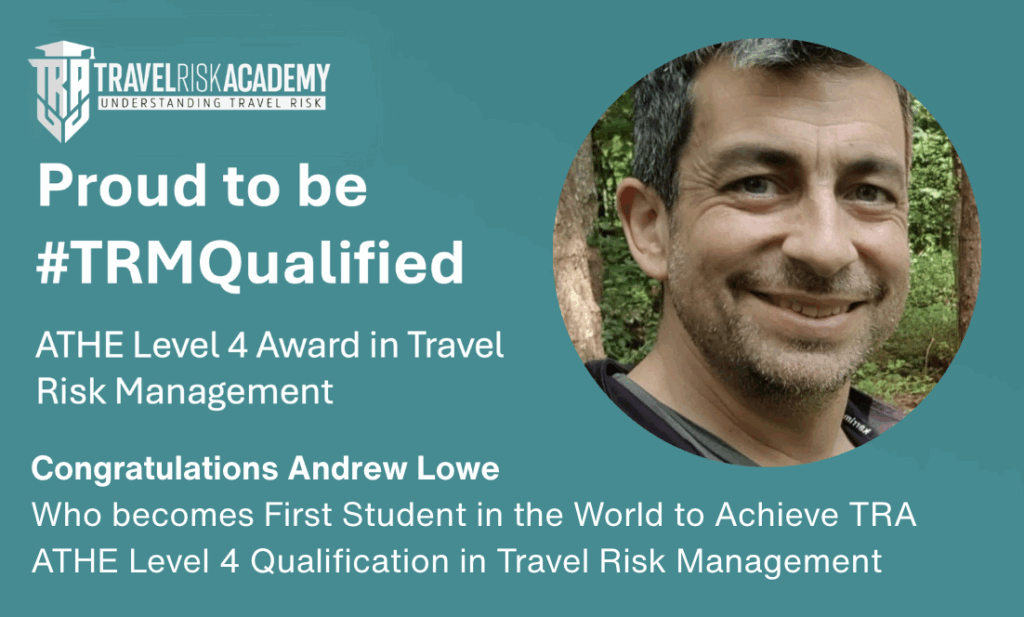
A Global First: Andrew Lowe becomes the World’s First Graduate of the Travel Risk Academy ATHE Level 4 Qualification in Travel Risk Management.

Andrew Lowe of BP becomes the World’s First Graduate of the Travel Risk Academy ATHE Level 4 Qualification in Travel Risk Management. We are proud to announce a major milestone: Andrew Lowe, Travel Risk Manager at BP, has become the first person to achieve the Travel Risk Academy Level 4 Qualification in Travel Risk Management, independently accredited by ATHE. This moment marks a significant step forward for a profession that is rapidly gaining recognition as essential to global business resilience, duty of care and organisational security. A trailblazer for the profession Andrew’s path into Travel Risk Management began within BP’s Global Security Operations Centre (GSOC), where he helped define what TRM should look like for one of the world’s largest energy companies. From mapping global travel risks to creating frameworks and embedding best practice, his work has set a benchmark for modern Travel Risk Management roles. By becoming the world’s first graduate of the Travel Risk Academy ATHE Level 4 qualification, Andrew has demonstrated how structured training and accreditation can elevate both individual capability and organisational confidence. Andrew commented on his learning journey: “This qualification is a milestone in my journey as a travel risk manager, helping to both solidify and expand my knowledge and experience. Certification is especially important at a time when the profession is being increasingly measured against ISO 31030.” He added that the course provided clarity, structure, and challenge: “The self-paced format worked very well around a busy schedule. The tutorials were invaluable for validating and at times challenging my understanding, prompting real self-reflection.” In recognition of his dedication and pioneering achievement, we are delighted to welcome Andrew as a Travel Risk Academy Ambassador. A new era for travel risk professionals With this announcement, Travel Risk Academy is opening enrolment globally for its ATHE Level 4 and Level 5 Qualifications in Travel Risk Management – offering a clear, accredited pathway for those responsible for keeping travellers safe in an increasingly complex world. With special thanks to our Level 4 sponsors; WorkFlex, Terrain 9, Compass Point Assist, Voyage Manager and Sectrn.   For more information on both our Level 4 and Level 5 Travel Risk Management Qualifications, visit >

A Global First: Andrew Lowe becomes the World’s First Graduate of the Travel Risk Academy ATHE Level 4 Qualification in Travel Risk Management. Read More »

Is Your Emergency Plan Missing a Pulse? The Case for Medical Support

Do Organisations including, Security Managers Forget About Medical Assistance? Is that an insightful or inflammatory question?  TRA Mentor Thierry Montrieux gives us his considered opinion and some trips on addressing it if the answer is anything other than NO. Security managers focus heavily on threats like theft, violence, cyberattacks, or physical intrusions—but medical assistance can sometimes get overlooked by the organisations. From my experience a few of the common reasons why this happens are:   Perceived Scope of ResponsibilityMany security managers view their role primarily as preventing security breaches, not handling health or safety. They assume medical emergencies fall under HR, health & safety, external emergency services or their designated emergency medical assistance company if one is appointed directly or via an insurance policy. Training BiasSecurity training often emphasises surveillance, access control, and emergency response for hostile threats. General first aid and medical response may be optional or underemphasised, so it doesn’t stay front of mind. Reactive vs. Preventive MindsetSecurity teams often operate in a reactive mode, preparing for intrusions or incidents. Medical events (like heart attacks, asthma, or fainting) can feel less predictable and thus get pushed aside, even though they’re statistically more likely. Budget & Resource AllocationCompanies often allocate resources to visible security measures (guards, cameras, alarms) rather than medical preparedness (AEDs, first aid kits, staff training). Over-reliance on Emergency ServicesSecurity managers sometimes assume that calling the emergency service is “enough,” forgetting that in many emergencies (e.g., cardiac arrest), the first few minutes of on-site response matter most. Cultural FactorsIn some organisations, there’s a culture of separating “safety” and “security.” This silo effect leads to gaps in holistic emergency planning. Statistically, medical emergencies are far more common in workplaces than violent intrusions, so integrating medical preparedness into security planning makes organisations safer. Whilst there are no published statistics experience tells me for every 100 incidents around 99 will be for some sort of medical emergency ranging from the simple cut to the life threatening. To help, I have put together some practical steps security managers can take to make sure medical assistance isn’t overlooked in their emergency planning: 1. Integrate Medical Response into Security Protocols Add medical emergencies (heart attacks, seizures, allergic reactions, injuries) into the same emergency response playbooks used for fire or security threats. Treat “first aid readiness” like fire extinguishers or CCTV — something that needs inspection, upkeep, and drills. 2. Train Security Personnel in First Aid Require at least basic First Aid, CPR, and AED training for all security staff.  Build this into your TRM training package. Make refresher courses mandatory (skills fade quickly if not practiced). Encourage cross-training with health & safety teams. 3. Equip the Environment Ensure AEDs (defibrillators) and first aid kits are strategically placed and checked regularly. Include trauma kits (tourniquets, pressure bandages) in areas where workplace accidents or active threats are possible. 4. Improve Communication & Coordination Establish a clear medical emergency chain of command (who calls EMS, who assists the patient, who manages crowd control). Make sure any security guards know how to guide paramedics quickly to the scene (lost minutes in large facilities are critical). Who contacts the medical assistance company and when 5. Run Joint Drills Include medical scenarios in emergency drills (e.g., simulated heart attack in the lobby, choking in the cafeteria). Involve your medical assistance company or consult a medical assistance industry expert. This makes response smoother and reduces hesitation during real incidents. 6. Leverage Technology Some security systems can integrate with panic buttons or health monitoring wearables for lone workers. CCTV operators can be trained to spot medical distress (slumping, collapsing, seizure-like activity). 7. Break Down the “Silo Mentality” Collaborate with HR, health & safety officers, and local emergency services, your medical assistance company or consult a medical assistance industry expert. Security should see themselves not just as protectors from external threats, but as first responders in all emergencies. By reframing “security” as protection of life first,  vulnerabilities second, medical preparedness becomes a natural extension of the role. Here’s a short checklist security managers could use directly in their planning, or more of a policy guide that could be adopted at an organisational level. Security & Medical Assistance Checklist 1. Training All security staff trained in First Aid, CPR, AED use Regular refresher courses scheduled Cross-training with Health & Safety team 2. Equipment AEDs installed in high-traffic areas and checked monthly First aid kits fully stocked and inspected Trauma kits available where high-risk incidents may occur 3. Procedures Medical emergencies included in security protocols Clear chain of command for medical incidents Defined role for security: first aid, scene control, EMS escort 4. Drills & Coordination Regular medical emergency drills conducted Security staff know how to guide EMS quickly to incident location Coordination established with local hospitals/EMS 5. Communication & Awareness Emergency numbers posted and known to all staff Security can communicate calmly and clearly under stress CCTV/monitoring staff trained to spot signs of distress 6. Culture & Responsibility Security team recognizes role as first responders Medical preparedness seen as equal priority to threat response Collaboration with HR & Safety teams maintained Never be afraid to seek, help, support and advice from people that have the experience to build the knowledge you need to provide the duty of care for your teams and staff.

Is Your Emergency Plan Missing a Pulse? The Case for Medical Support Read More »

TRA Guide to Travel Optimization

TRA Guide to Travel Optimization At the Travel Risk Academy, we frequently discuss the importance of optimizing travel programs. In fact, our annual summit is dedicated to this very topic. But what exactly do we mean when we talk about Travel Optimization Management (TOM)? In this article, we’ll unpack the concept of TOM with TRA Mentor Bruce McIndoe and offer suggestions on how to apply it within your own organization. More Than Just Cost Management  Before diving in, let’s make one thing clear: optimizing a travel program goes far beyond simply managing costs. Travel is a business and organization enabler. At its core, TOM encompasses two equally important areas of focus.  Stakeholder Engagement Effective travel optimization requires collaboration across multiple departments. This means involving stakeholders from various parts of the organization, including HR, Procurement, Security, Risk Management, Audit, QHSE, Finance, Travel, Mobility, Facilities & Fleet, Marketing and Events, Cybersecurity, Data Security, Legal, Operations, Insurance, DEI, Sustainability, C-suite leadership, and, of course, the travelers, bookers, and approvers who interact with the program daily. These diverse perspectives ensure that the travel program is aligned with the broader needs and priorities of the organization. Alignment with Organizational Objectives Optimizing a travel program also involves aligning your travel strategy with your organization’s broader objectives. Travel is an enabler and a critical function in achieving these objectives. By integrating your organization’s culture and values into areas like traveler safety, wellbeing, and sustainability, you can create a travel program that supports the organization’s mission on multiple levels.  A Strategic Approach Yields Long-Term Gains  While this organization-wide approach may sound challenging, it’s important to recognize that the effort put in at the outset will return benefits over time. As a travel program evolves into strategic alignment with the organization rather than a cost center, the costs we are so eager to control naturally fall into line with a clear linkage back to the organization’s objectives.  Contrary to popular belief, optimizing your travel program does not necessarily mean spending large sums on technology or external consultants. The beauty of TOM lies in fully understanding what you already have in place. By thoroughly analyzing the current program, clearly aligning it to the organization’s stakeholders, and identifying gaps, you can begin to make meaningful improvements and start reaping the longer-term benefits.  Beyond Spreadsheets: A Holistic View of Your Travel Program  Optimization won’t happen by simply crunching numbers in a spreadsheet. It requires a hands-on approach—one that involves rolling up your sleeves and getting familiar with every element of the program. This includes those aspects that may have been overlooked, as well as those that appear to be working fine but could benefit from further refinement.  By staying open-minded and willing to go the extra mile in your due diligence, you can identify opportunities that might have otherwise been missed. The result is an optimized travel program that puts people at the heart of every decision, ultimately contributing to your organization achieving its goals—sometimes in ways you had not considered.  To get you started we have put together our top tips on Travel Optimization Management.    1. Engage Stakeholders Across the Organization Optimizing a travel programme isn’t just the job of the travel team—it requires input from all relevant stakeholders across the organization. As listed at the top of this article, this can include HR, finance, security, compliance, and the travelers themselves. Consider creating a Travel Council or Travel Optimization Team (TOT). Involving stakeholders is crucial in:  Understanding needs and priorities: Different departments may have different priorities. Finance may focus on cost control, while HR may prioritize traveler well-being and security and look after recruitment and often mobility.  Your marketing team may be responsible for running events and have a different set of needs and risks, they can also help you communicate the programme internally. Creating a collaborative framework: By engaging everyone in the process, you can build a travel programme that meets the needs of both the organization and its travelers, leading to better buy-in and compliance. Mapping current versus future state: Stakeholders can help you define where your travel program is today versus where it needs to be. Their feedback can help map a clear path toward achieving an optimized travel programme that serves the goals of the organization and the safety of its people.  Your Travel Optimization Team will become your Travel Optimization champions; they can link to other committees or report to the C-Suite and take ownership of the direction of the program.  2. Conduct a Thorough Analysis of Your Current Program Before optimization, a comprehensive analysis of your existing travel programme is crucial. This involves: Conduct a SWOT for each functional area. “Why do we travel?” and “How do we enable safe travel?” What is their value proposition for travel and is the travel programme helping achieve it? Evaluating current policies and procedures: Are they clear, up to date, and effective? How are they being communicated, across all stakeholders.  Identify any gaps or areas that need improvement. Measuring performance: Analyze the collection and assessment of key metrics like traveler satisfaction, policy compliance, travel-related incidents, and cost efficiency.  Mapping pain points: Talk to travelers, travel arrangers, and other stakeholders to uncover bottlenecks or issues, such as confusing policies or slow response times during emergencies.  This analysis will help you understand where your programme currently stands and provide insights into areas that need to be adjusted or optimized.  3. Understand Your Supplier Partners and Their Services and Capabilities It’s essential to have a deep understanding of the services and capabilities that your supplier partners provide, how they overlap, and where there are gaps. You may have several partners offering similar services, such as traveler tracking tools, global mobility, visa and immigration, meetings and events, online booking tools, security alerts, or insurance/emergency assistance. A clear understanding of these overlaps will help you:  Reduce redundancy: If multiple suppliers offer similar services, you can eliminate overlap and streamline your program. For example, you might find that two partners offer traveler tracking, and one


TRA Guide to Travel Optimization Read More »

Bridging Silos in TRM: 5 Key Steps to Keep Employees Safe

Bridging Silos in Travel Risk Management: 5 Key Steps to Keep Employees Safe As companies expand globally, the need for a solid travel risk management programme becomes more critical. Yet, establishing this programme can be challenging, especially when departments like People Management, Vendor Management, Corporate Mobility, and Security have their own goals and responsibilities. These silos can lead to communication gaps, misaligned priorities, and missed opportunities to keep employees safe and supported. Now more than ever, leaders are seeking ways to foster collaboration for more effective travel risk management. Without aligned strategies and open communication, essential travel safety initiatives can face delays or even be compromised. Bridging silos is crucial to keeping travel risk management efficient, responsive, and proactive.    Why Silos Are Hard to Bridge — and Why They Matter in Travel Risk Management Silos naturally form as organisations grow and teams have specialised goals. By bridging these silos, companies can create an organised, effective travel risk management programme. Here are five key steps to help teams work together seamlessly.  5 Steps to Bridge Silos in Travel Risk Management    Align Leadership Across Departments Effective travel risk management programme needs a unified approach driven from the top. Leaders from People Management, Vendor Management, Corporate Mobility, and Security should regularly meet to create a shared vision and align on travel risk priorities. Forming a cross-departmental leadership team or steering committee helps ensure that each department understands its role in keeping travellers safe and how it fits into the company’s larger goals. Build Cross-Functional Travel Risk Teams Combining insights is essential for a comprehensive travel risk strategy. These cross-functional teams allow each department to share expertise. This collaborative approach results in travel programmes and policies that are both safer and more effective for everyone involved. Define Clear Roles and Responsibilities When multiple departments work together, roles can overlap. Define each team’s responsibilities within a travel risk management programme to ensure clarity. Clear roles help teams stay organised and focused on their unique responsibilities. Appoint Co-Leaders from Each Department For travel risk projects that require deep collaboration, appointing co-leaders from different departments helps balance priorities. For example, co-leaders from People Management and Vendor Management can ensure employee well-being and cost-efficiency, while a Security co-leader ensures that thorough risk assessments are factored in. This co-leadership model supports a balanced approach to decision-making.  Prioritise Travel Risk Training Across Departments Travel risk training is essential for equipping teams to support and protect employees effectively. Training ensures that each department understands travel risk protocols, their specific responsibilities, and the resources available for travellers. When employees are trained to work together across departments, they’re better prepared to act swiftly, manage emergencies, and collaborate effectively in high-stakes situations. This unified approach to training also builds a stronger, more informed travel risk management culture across the organisation.  The Path to a Strong, Unified Travel Risk Management Programme  Building a strong travel risk management programme is essential for ensuring employee safety in an unpredictable world. By adopting these five strategies and prioritising training, organisations can create a cohesive programme that is flexible, responsive, and prepared to tackle the challenges of a constantly changing environment. This approach will help companies to stay resilient and ensure the safety of employees, no matter where they travel. 

Bridging Silos in TRM: 5 Key Steps to Keep Employees Safe Read More »

Creating a travel risk management policy

Creating a Travel Risk Management Policy A comprehensive Travel Risk Management (TRM) policy should include several key elements to effectively mitigate risks, ensure traveller safety, and meet duty of care obligations. Below are the critical components that a TRM policy should include:  Purpose and Scope * Define the purpose of the TRM policy and who it applies to (e.g., all employees, contractors, guests etc.) * Outline the scope, including all travel types (domestic, international, high-risk regions, etc.) and the activities covered (business trips, conferences, maintenance etc.) Risk Assessment and Travel Approval Process * Establish a clear process for assessing the risks of a travel destination, considering factors like security threats, health risks, political stability, and environmental concerns. * Detail a pre-travel approval process that evaluates the necessity of travel, the travellers own preparedness, and specific security measures for high-risk destinations. Duty of Care Obligations * Highlight the organisations legal and ethical duty of care responsibilities to ensure the health, safety, and security of its travellers. * Include guidelines for employees to follow during travel, covering expected behaviours and personal responsibilities. Roles and Responsibilities * Define the roles and responsibilities of key stakeholders involved in travel risk management, such as HR, security teams, travel managers, and travellers. * Identify the team who is responsible for monitoring risk levels, communicating with travellers, and managing emergency responses. Traveller Education and Training * Specify the training required for travellers, including pre-trip briefings on health, safety, security, and cultural awareness specific to the destination. * Include resources such as travel safety tips, medical advice, and emergency contacts. Emergency Response and Crisis Management Plan * Provide clear protocols for responding to travel-related emergencies, including medical incidents, security threats, and natural disasters. *Outline communication procedures and designate emergency contacts both at the company and locally, including any third parties. Include evacuation /shelter in place plans and insurance details. Health, Safety, and Security Measures * Establish standards for safe accommodation and transport options, ensuring they meet health, safety, and security criteria. * Provide guidance on managing personal health during travel, including vaccinations, medications, and travel insurance coverage. Traveller Tracking and Communication * Implement a system to track travellers during their trips, ensuring real-time monitoring of their locations. * Include protocols for regular check-ins and emergency communications to maintain contact with travellers. Incident Reporting and Post-Trip Debrief * Establish a process for reporting safety or security incidents during travel, including near misses and emergencies. * Require post-trip debriefing to identify any issues faced and capture feedback for improving future travel safety measures. Insurance Coverage * Detail the insurance policies available for travellers, including health, accident, repatriation, and travel disruption coverage. * Ensure that the policy aligns with local regulations and provides sufficient protection for high-risk or high-risk activity travel. Legal and Regulatory Compliance * Ensure that the TRM policy complies with relevant local, national, and international regulations, including health and safety laws, and aligns with ISO31030:2021 Travel Risk Management guidelines. * Include guidance on compliance with local laws and customs in the travel destination. Continuous Monitoring and Policy Review * Establish procedures for continuously monitoring travel risks and updating the policy as needed to reflect new risks or changes in travel environments. * Include a formal review process to assess the effectiveness of the policy and incorporate lessons learned from previous travel incidents or feedback. Traveller Well-being and Support * Address the well-being of travellers, including mental health support, stress management, and maintaining work-life balance while travelling. * Provide access to resources like employee assistance programmes (EAPs) or assistance services during travel. At the Travel Risk Academy, we offer a multitude of resources and good practices to help guide you on your journey to protecting your travellers effectively.  We align with the practices set out in ISO31030 and work with a myriad of experts across the widest scope of TRM.  Find out more about our services here; membership has additional benefits, and we look forward to welcoming you to our diverse community soon. 

Creating a travel risk management policy Read More »

Shopping Basket
Scroll to Top